Sunday, 6 December 2020

What we can learn from forests


From the New York Times - The Social Life of Forests

In the New York Times Magazine this weekend is a beautifully presented piece on how trees communicate and more through a subterranean network called mycorrhiza. Called The Social Life of Forests the article explains this phenomena.  Not only do trees communicate signs like danger through these networks, but they also exchange nutrients with other trees over the seasons or in response to other stimuli.  The article is a fascinating read.

A lot of this information is based on the work of a scientist named Suzanne Simard.  Her early work was initially dismissed as the idea of trees forming these complex networks of co-dependence did not sit with the Darwinian view, which posited that each tree acts individually in a struggle for survival.  Simard's work is now much more accepted in her field.

As I was reading this article it reminded me of a great book I read a couple of years ago called The Overstory by Richard Powers.  One of the characters in the book shares a similar story to Simard's in being ignored at first for her findings and then lauded by later scholars.  Sure enough as I read the NYT article Powers' book is mentioned and that the character in the novel is based on Suzanne Simard.

I had just assumed the theory of subterranean networks in forests was a fictional device for Powers' novel.  So I was pleasantly surprised that in fact it was based in science and that these networks actually exist.

It also made me think a little about the great lie we are told about how competition and individualism is the natural state of humanity and the basis for human progress.  If 2020 has taught us anything it's that we absolutely rely on one another and cooperation and collaboration are key to our survival.  That is something we can also learn from forests.

Until next time, peace and love.


Sunday, 29 November 2020

Prague - July 2016


 The 'Fred and Ginger' building by Frank Gehry - Prague July 2016

Sunday, 15 November 2020

Miles - The Autobiography


I am reading a new book this week.  The autobiography of Miles Davis.  I never knew this book existed until I accidentally saw it in a list of  'best music bios'.  I'm up to about 1958 and Miles has just recorded Milestones with his sextet at the time, which featured the great saxophinists John Coltrane and Cannonball Adderley.

It's an entertaining read and not at all what I expected.  I'm not sure I'd put it up a list of 'greats', but if you have a vague interest in his life and the music of his era then put it on your list.  There's great passages about Charlie Parker, John Coltrane and other greats.  Miles doesn't hold back in the criticism of people who he thought were undeserving of attention.  He has no time for the racist attitudes in America either and expresses his views in strong terms.

Recommended for music lovers.

Until next time, peace and love.

 Postscript: I finished this book and have to say I really enjoyed it.  What a life he lived.  Although as a human being Miles Davis made a great musician.  There's no doubt he was a very difficult person and some of the story casts him in a very unfavourable way.  And yet it his story and he was willing to tell it in all its ugliness and rawness.  Above everything else he was all about finding new sounds and exploring his art to the end.  I highly recommend this book.

Richard Flanagan - The Living Sea of Waking Dreams


Richard Flanagan has a new book - The Living Sea of Waking Dreams.  As I think he is one of Australia's greatest authors I ordered a copy as soon as it was released and read it in a couple of days.  Set at the time of Australia's 2020 bushfire season, the story centres around a dying elderly mother and the 'management' of her decline by her three children.  

As the apocalyptic bushfires consume Australia a strange phenomenon affects some of the central characters - parts of their bodies start to disappear; their fingers, a knee, eyes even.   More strangely, other people do not notice these absent features.  The seemingly imminent extinction of the orange bellied parrot also features in the story.  While these events occur, characters disappear into their phones, consuming news and social media, all so they can escape having to acknowledge the terrible events surrounding them.

This is a book about our culture of indifference to suffering and the seemingly inexorable death of the planet.  At times I found it grim reading, but Flanagan's wonderful writing kept me hooked.  For me there was a note of hope in the ending which pulled me out of the darkness.

Recommended reading to anyone who can read.

Until next time, peace and love.

Sunday, 8 November 2020

The Hare with Amber Eyes and the Ephrussi family


The Palais Ephrussi in Vienna in August 2016

In 2013 I read a fascinating book by Edmund De Waal titled The Hare with Amber Eyes which tells the story of the Ephrussi family and their descendants, of which De Waal is one, from the early 19th century through to the present day.  The title of the book is taken from a netsuke (pronounced nets-skay) in De Waal's posession which has been passed down to him through the family.  A netsuke is a small hand carved figurine from Japan typically made from wood or in some cases ivory.  Netsuke can be centuries old and extremely valuable as pieces of art.  De Waal inherited a collection of 264 netsuke from an uncle.


De Waal tracks the history of how the netsuke came to be in the family and in doing so goes back to the origins of the Ephrussi family in Odessa in Russia.  The Ephrussi family became wealthy from the grain business in Russia and sent their sons off the to the capitals of Europe to make their fortunes in banking and business.  One of the sons settles in Paris and not having much interest in business becomes a patron of the arts and a fixture in the Paris salons.  This happens to coincide with the Meiji era in Japan where that country started to open up to the rest of the world after centuries of isolation.  Japanese objet d'art became all the rage among the elites in Paris and the Ephrussi family soon acquired Japanese art, including the collection of netsuke, to go along with their growing collection of European art.

 The Hare with Amber Eyes on exhibition*

Jumping forward to the 1930's the netsuke are passed down through the family and end up in Vienna.  The Ephrussi family by this stage are wealthy financiers and art collectors and reside in grand Palais Ephrussi on the Vienna Ringstrasse in the centre of the city.  In 1938 the Nazis annex Austria (the Anschluss) and establish their headquarters in the Palais Ephrussi, evicting the family and taking possession of the family's artworks and valuables, including the netsuke.  The family lose everything and spend what money they have in escaping to Britain.

I won't reveal anymore, but how the netsuke come to return to the Ephrussi family is extraordinary and tragic at the same time.  Of the family fortune nothing was ever repatriated to the family and the artworks disappeared across Europe.  After the war the Austrian Government also refused to hand back the Palais Ephrussi to the family.  It still stands in the centre of Vienna and the photo above is one I took when I visited the city in 2016.  After having read the book it was a wonderful experience to find the Palais and reflect on the history which played out within its walls.

In 2014 I visited Japan and found some netsuke for sale in a shop in Nikko.  A beautiful  little town which has a rich history itself.  I never purchased the netsuke, a decision I regret now, but one I hope to rectify one day if I ever travel again to Japan.

I cannot recommend The Hare with Amber Eyes enough as a book.  It spans a tumultuous time in European history and is beautiful and tragic and never less than fascinating.

Here's a short video of Edmund De Waal speaking about netsuke.

Until next time, peace and love.

 *By Gryffindor - Own work, CC BY-SA 4.0, https://commons.wikimedia.org/w/index.php?curid=53413030

Friday, 30 October 2020

My Back Pages


Tonight I listened to one of my favourite Bob Dylan records - Another Side of Bob Dylan.  Released in 1964 it's his fourth album and the last of his acoustic records before he went electric.  Apparently it was recorded in one night with just him on a stool in the studio with his guitar, cigarettes and a couple of bottles of red wine.  

There's still a thread of the social consciousness of his earlier records present in Chimes of Freedom, but more dominant was the beginnings of his free association style of writing which really took hold in the records that followed like Blonde on Blonde.  There's also a love song or two.  While musically still 'folk' he seems to have decided to leave the protest songs behind.  Woody Guthrie was no more.  Needless to say this upset many of his fans at the time.

There are many outstanding songs on this record and one of my favourites is My Back Pages.  The song is widely interpreted as his rejection of his political music with the line:

Ah, but I was so much older then,
I'm younger than that now

No-one really knows what Dylan is on about most of the time and I for one am not about to start to try and work him out.  I just dig the song and I hope you do too.

Until next time, peace and love.

Saturday, 17 October 2020

Roxy Music - Mother of Pearl Live 1976

One of my favourite Roxy Music songs is Mother of Pearl from the 1974 lp Stranded. Here's a live version from 1976. The band is in fine form.  Enjoy.

Robert Fripp

I don't know much about Robert Fripp, the guitarist from King Crimson and Bowie / Eno collaborator and anyone else whoever mattered.  So I was interested to read this reprint of an interview with Fripp from 1974 where he announced the end of King Crimson.  As many people know the band continued on for a few decades after this, but that's beside the point.  

It's a fascinating interview of a very unique person.  There's quite a bit of young man's intellectual arrogance on display here, but it gives an insight into his singular way of thinking. His predictions for the USA and the world haven't transpired, although it feels like the end of times for America right now.

Anyway, I hope you enjoy this interview as much as I did.  You can read it here .

Sunday, 27 September 2020

How to straighten a warped record.


Fixing Australia Post's handiwork

Recently I had the misfortune to receive two shipments from Australia Post containing lp records.  Aside from being expensive and appallingly slow to deliver anything, even across town, Australia Post shows a complete indifference, or perhaps malicious intent, for the welfare of the parcels in its care.  In both cases the records have arrived bent like bananas after having been squashed by other parcels.

The first lp was a record by The Fall which was warped, but still just playable.  I contacted the seller and they gave me a partial refund.  The second lp arrived completely warped out of shape to the point it would not play at all.  Needless to say I was most displeased to have this happen again.  I consulted the AustPost website to see what was ahead of me in terms of making a claim.  It was possible, but it barely seemed the trouble.  The seller offered to send me through another copy, but I didn't think it fair that a small record shop should have to cover the cost of AustPost's negligence.  I therefore thought I would try and straighten the record before making a claim.

As one does, I consulted the internets to see what methodology I ought to employ.  It comes down to about three:

  1. Heat the record between two sheets of glass at about a temperature of 80 degrees for 10 minutes or so
  2. Press the record down with some heavy books
  3. Don't warp the record in the first place.

I immediately ruled out option three as I had passed that point. There were conflicting opinions on option one and it looked risky.  The videos I watched seemed to work okay, but others cautioned against this approach.  I thought I would adopt a cautious approach and try option 2 - weigh the record down with some heavy books.

From the picture above you can see there was nothing scientific about my approach.  I looked about the house for some weighty tomes and placed them on the record. All up the books weighed 11.4 kgs.  After about three days I started to see some results and the record was noticeably straightening.  Encouraged by these early results I persevered with the method and left it another week.

After another check things were looking good, however there was still a noticeable bend.  I decided to try a variation on the methodology as can be seen in the next photo.

A variation on option 2
 

I positioned the record in between two books and above the desk.  I then placed a single book on top of the record against the "warp" in the record.  I did this in one day intervals and checked my progress.  This was quite successful and after a few days most of the warp was gone.  A test on the turntable showed the record was now playable.  It's not perfect and the record's value is nothing, but I don't care about that sort of thing.  As long as I can play the record I'm happy.

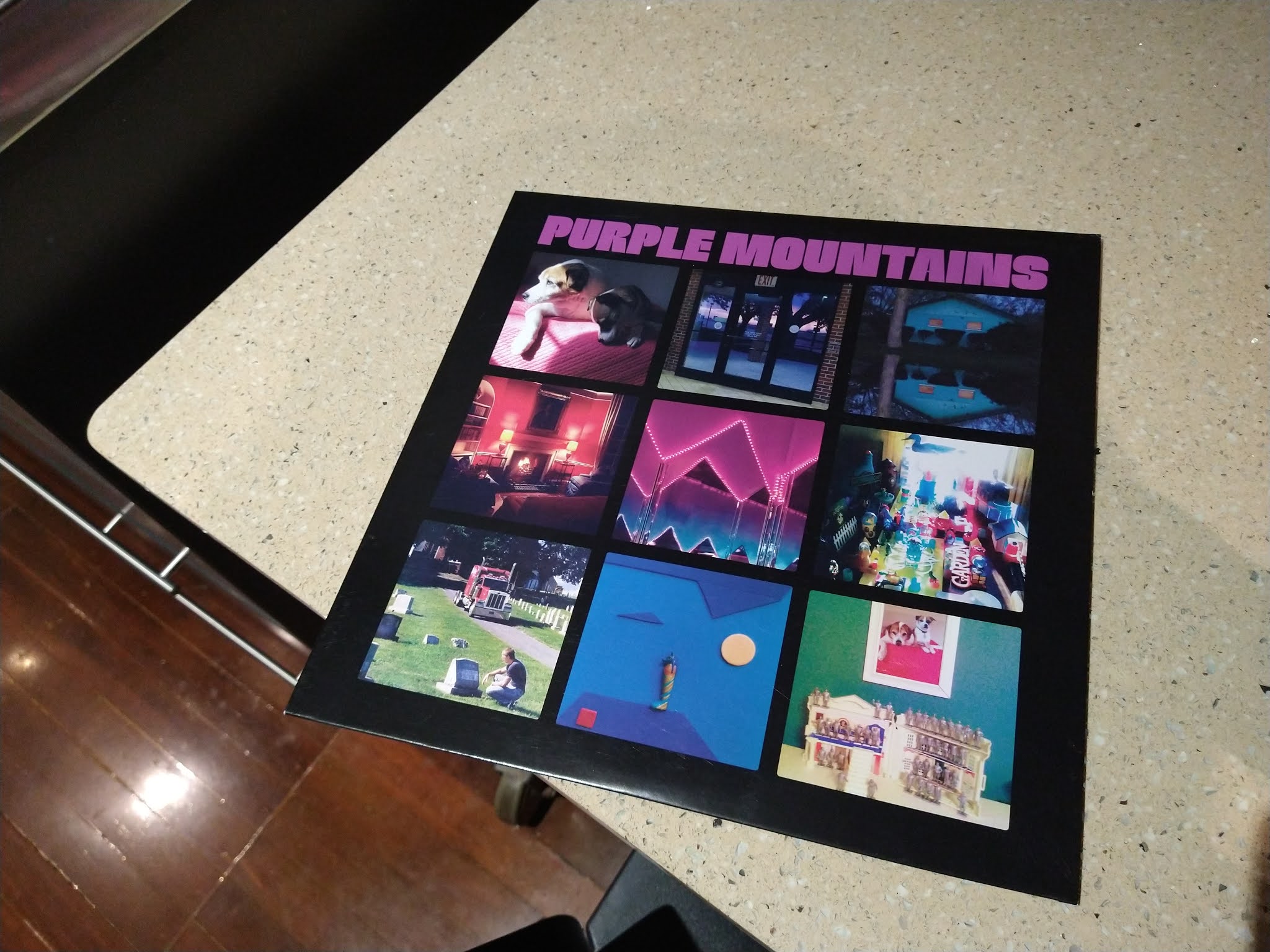
So what is that record you say?  It's the self-titled Purple Mountains album from 2019 and to these ears it is one of the best releases of recent years.  A certifiable classic.  Unfortunately there is a lot of tragedy associated with this record with the early passing of its creator David C. Berman - one of the finest lyricists of any generation.  I highly recommend this album.  Until next time - peace and love.


Berlin - August 2016


 At the front door of David Bowie's apartment in Berlin